DIGITAL SKILLS 2

By Elias and Dana

References

gamemusicisgood. (2008, March 8). Nintendo Wii – Mii Channel Theme . Retrieved from https://youtu.be/po-0n1BKW2w.

donyaali1. (2010, April 20). Dana- Ana Dana . Retrieved from https://youtu.be/LjjFy5UJtYQ.

Buzz Lebanon. (2012, October 1). Buzz – “Khalleh el jaww wel3an” sequel – pool barbecue . Retrieved from https://youtu.be/o2p-u3_pgb0.

Rotana. (2012, October 7). Fares Karam El Tannoura  فارس كرم – التنورة  . Retrieved from https://youtu.be/UJdtg-XtG1c.

SaveMySheep. (2013, January 27). Uncharted (Empire Syndicate – The Long Journey) . Retrieved from https://youtu.be/dvB6Mo1DUIQ.

The Rubin Report. (2015, March 12). Lebanese News Anchor Shuts Down Sexist Guest (Amazing Video) . Retrieved from https://youtu.be/wYRVFw_zABg.

Lebanon Times. (2019, April 3). . Retrieved from https://www.instagram.com/p/B-hIuMkngyN/?igshid=ooogp30bf2v1

Lilia.haj. (2019, April 10). It’s not a pov. It’s real life. . Retrieved from https://vm.tiktok.com/TBYmfN/

BBC Monitoring. (2019, November 22). Lebanese women kick back . Retrieved from https://youtu.be/3UlSt66mDWE.
Class Exercise – Sound Mapping

C: generator, talking

R: birds , horn, cars, keyboard clicking, cigarette burning, hitting table

U: cats, lighter clicking, garage door closing

N: birds, cats

H: talking, horn, keyboard clicking, lighter clicking, cigarette burning, cars, hitting table, garage door closing

T: generator

M: horn, cars

Close: keyboard clicking, cigarette burning, sister hitting table, lighter clicking

Far: generator, talking, horn, cars, birds, cats meowing, garage door closing

The ambient sound recording seemed to lack the sound of birds. However, it added sounds of static and popping to the audio. Furthermore, the sound of the generator running was not particularly present in my childhood nor my parents. Sadly, the most familiar sounds I looked for and could not find were those of dogs barking and leaves rustling. The noisiest point of these ten minutes are from 6:15 to 8:15.

It is worth noting that I never knew there was so much noise and sounds around me. I thought it was pretty quiet.

The digital resistance

From simple protests to country-wide revolutions, media has proven time and time again to be an extremely useful tool in getting people’s voices across, especially considering how it is usually controlled by the government that sends its own oppressive messages to the world. This could not be truer in the case of the Zapatista movement, where the rebels were one of the first to utilize the media for their advantage and gain internal and external momentum because of it (Padgett, 2017). Looking at the Palestinian situation, one may notice that the international community either hears what the United States spreads about the situation in the Middle East, or simply does not care enough to be bothered with it. Usually it is the latter, and I would argue that that is due to the lack of appearance Palestinians have in media; they do not exist for anyone but themselves and the nearby Arab regions. If Palestinians focused more on countering the dominant American narrative created for them based on vilification and terrorism, they could succeed in humanizing themselves in the eyes of the international community and garner more support for their cause and their rights. Activism is really important, and if practiced well, then silencing Palestinian activists would result in voices being louder and the tactics of oppression would backfire. People are ready to fight for a cause, an undying pure idea, they just need to be showed where it is and why it is worth it.

References

Padgett, R. (2017). Radical Legacy of the Zapatista’s Media Strategy – SVLLY(wood) |. Retrieved from http://www.svllywood.com/intifadaessays/radicalmedia

Prison radio

Prison radio exists as an internal function, however, the most prominent role the radio plays is one involving the image it portrays of the prisoners to the outside world (Anderson, 2013). In order to truly understand how prison radio is expressed, one may need to delve into how “active community” and “free radio” interlink with it. Active community, as described by Fanon (1965), is how communities, in our case prisoners, would come together and utilize the radio and other media outlets instead of shying away from it and allowing it to oppress them. On that note, “free radio” is only achieved when it is stripped away from corporate and governmental censoring and reclaimed by the people who wish to make their voices heard (Dunifer, 2010). Realistically, prisoners are a long way from achieving this autonomy of broadcasting and ability to express themselves freely. In most cases, prisoners’ are rarely humanized, and their voices are channeled through the mouths of broadcasters or family members due to the censorship imposed by correctional facilities and governments (Abu-Jamal, 2013). Such censorship, may it be due to political pressure, corporate gains, and keeping a broken system alive etc., ultimately results in the marginalization of inmates. To combat this reality, as Anderson (2013) points out, some shows have taken the initiative of spreading truths regarding the prison systems. These shows include “Sunday Night Request show”, “Green Bush Request show”, and “Jailbreak”, etc. Going a step further are programs that focus on the inclusion of inmates in activities revolving around  community interaction, thus combatting isolation and ultimately reducing chances of reoffending Anderson (2013).

References

Anderson, H. (2013). Facilitating active citizenship: Participating in prisoners’ radio. Critical Studies in Media Communication, 30(4), 292-306.

Abu-Jamal, M. (2013). Media matters: Radio in prisons.

Dunifer, S. (2010). Islands of resistance: pirate radio in Canada. Vancouver: New Star Books.

Fanon, F. (1965). This Is the Voice of Algeria. Campus in Camps. Retrieved from http://www.campusincamps.ps/wp-content/uploads/2015/10/fanon-this-is-the-voice-of-algeria.pdf

Fake news

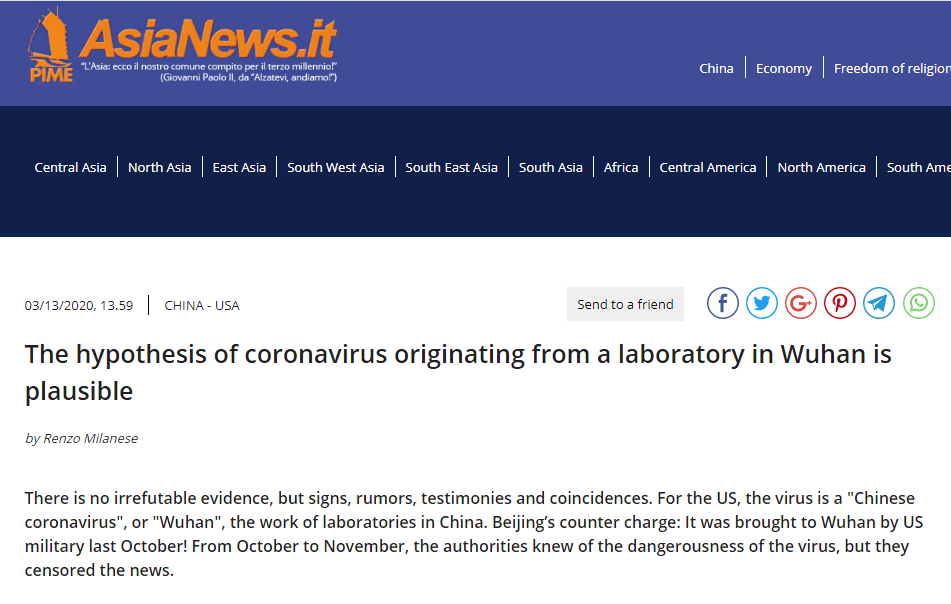
Fake news has always been a prominent part of media. We encounter it on a daily basis, may it be on WhatsApp, Facebook, local news outlets, and international news etc. The screenshot above is of an article written by “AsiaNews”, an article claiming the plausibility of COVID-19 having originated in China. Though the article never explicitly pretends to have proof of such allegations, it does not fall short in enforcing them. By utilizing the infographic provided by “eavia”, this article can be categorized into multiple factions (Steinberg, 2017). First, this article enforces propaganda, this is due to the political tension between the United States and China that has been escalating the blame game (Steinberg, 2017).  Secondly, the title is in itself a clickbait (Steinberg, 2017). As shown in the screenshot, the title portrays a sense of certainty or existence of some sort of proof, though the article is quick to note that it lacks any semblance of such. Clickbait is useful to get clicks on the site, ultimately generating ad revenue (Steinberg, 2017).  Thirdly, the article enforces a conspiracy theory revolving around the idea that China has some sort of political and economic gain from spreading the virus and succeeds at doing so considering the fear and anxiety revolving the virus around the world (Steinberg, 2017).  Furthermore, the article specifies that all it says is speculation, thus making its theory unfalsifiable due to lack of proof to contest. Finally, in order to combat this spread of fake news, one of the most important game-changing factors according to Kumanyika (2018) is making sure that people have the tools to identify fake news, in other words be well versed in media literacy so they may think critically of fake news and disregard it directly.

References

Kumanyika, C. (2018). Pour en finir avec les fausses nouvelles. Retrieved from:  https://www.youtube.com/watch?v=t10ErbfwG14&feature=youtu.be

Steinberg, L. (2020). Infographic: Beyond Fake News – 10 Types of Misleading News – Sixteen Languages. Retrieved from https://eavi.eu/beyond-fake-news-10-types-misleading-info/

Milanese, R. (2020). The hypothesis of coronavirus originating from a laboratory in Wuhan is plausible. Retrieved from http://www.asianews.it/news-en/The-hypothesis-of-coronavirus-originating-from-a-laboratory-in-Wuhan-is-plausible-49550.html

Independent alternative journalism

It is common knowledge that media suffers from the problem of being controlled by the few elites or influenced by political parties and corporations through shareholders and sponsorships. A need for a counter-narrative grew increasingly intolerable, leading to the creation of what is commonly referred to as “alternative journalism”. An example of such alternative journalism is “Independent Media Center” (Indymedia). It is an open publishing center, with writers from all over the world covering a wide range of topics. Interestingly, according to Indymedia’s site, the media outlet was founded in order to cover the Seattle protests against WTO truthfully and in an organized matter. This falls in line with the most important condition for a news producer to be considered an alternative journalism outlet; according to Forde (2011), alternative journalism is a solution to contradiction mainstream media, and having the ability to discuss alternative views and beliefs regarding certain topics. Furthermore, though Indymedia was founded in Seattle, its decentralization and expansion around the world solidifies its independence and freedom from any and all forms of control and censorship. Another interesting fact about Indymedia is that is non-profit. The center depends purely on donations to sustain its domain and counts on individuals, whoever they may be, to help in organizing, developing and maintaining the website. This reinforces their independence since it exonerates them of any accusations of being profit-driven or controlled by sponsors/shareholders and thus removes any issues that could result due to ownership.

References

Forde, S. (2011). Challenging the news: the journalism of alternative and community media. Houndmills, Basingstoke, Hampshire: Palgrave Macmillan.

Website: https://indymedia.org/

The Facebook monopoly

The Facebook monopoly is a lot more twisted than many might think. According to https://www.internetlivestats.com/, at the time of writing the blog post, there are roughly 2.4 billion active users on Facebook and almost 60 million pictures have been uploaded to Instagram. This exemplifies the horrendous surveillance power that Facebook has and the immense amount of data they are capable of collecting on a daily basis. Not only does this generate insane amounts of income for Facebook, but it also gives Facebook incredible political power. This is particularly highlighted in the article “Instagram shuts down Iranian accounts after Soleimani’s death” clearly exemplifying how Facebook can shut down unwanted opinions in regard to politics. Activists, journalists and citizens all had their accounts shut down for speaking up against what had happened (Cockerell, 2020). When it comes to fighting such gruesome and invasive surveillance and control, the people have the power to speak out against surveillance and force governments to pass laws that would protect us (NBC news, 2018). It is only when people realize what is being done with their data that they would be ready to limit their digital footprint on the Internet, which would impact big corporates’ winning rates and force them to comply with the people’s will. In addition to that, once the corporate falls, the government quickly follows. This is due to the inseparability of politics and economy.

Reference

https://www.internetlivestats.com/

Cockerell, I. (2020). Instagram shuts down Iranian accounts after Soleimani’s death. Retrieved from https://www.codastory.com/authoritarian-tech/instagram-iran-soleimani/

The effects of surveillance

Many platforms track us, mostly for advertising purposes, but the extent and risk differ from one company to another. Facebook allows for three types of major surveillance (Vaidhyanathan, 2018). The surveillance of data focuses on deciphering our interests, wants and needs, inclinations, etc. and sends such data to advertising companies that will be able to customize the ads we receive based on what we like and even based on predictions of what we might like (Vaidhyanathan, 2018).  The second form of surveillance is the one practiced by the state. When the government takes our data to uncover criminal activity, inclinations of terrorism, and generally anything particularly illegal (Vaidhyanathan, 2018). This may not sound terrible, however it must be noted that some information can easily be misinterpreted and can lead to major consequences on the individual (Vaidhyanathan, 2018). The last form of surveillance and attack on privacy is when Facebook constantly attempts to enlarge our circle of friends, likely asking us to add people we have never met or seen, sometimes from other countries (Vaidhyanathan, 2018).  This, for obvious reasons, can be particularly dangerous and put us at major risks. Unfortunately, surveillance does not end there. Another major form of surveillance is the “surveillance tower” particularly exercised on Palestinian women (Odeh, 2018). Their research denotes how violence in real life, due to the Israeli occupation and limited Palestinian resources, is clearly reflected on digital platforms and heavily surveilled by family members (Odeh, 2018). This results in an excessive need for women to censor themselves, which counterproductively, still heavily subjects them to sexual harassment online (Odeh, 2018).

References

Odeh, S. (2018). A Violent Network Gender-Based Violence Against Palestinian: Women in Virtual Space. Kvinna till Kvinna.

Vaidhyanathan, S. (2018). Anti Social Media: How Facebook Disconnects Us and Undermines Democracy. Retrieved from https://archive.indianculturalforum.in/2018/08/18/anti-social-media-how-facebook-disconnects-us-and-undermines-democracy/

Design a site like this with WordPress.com
Get started