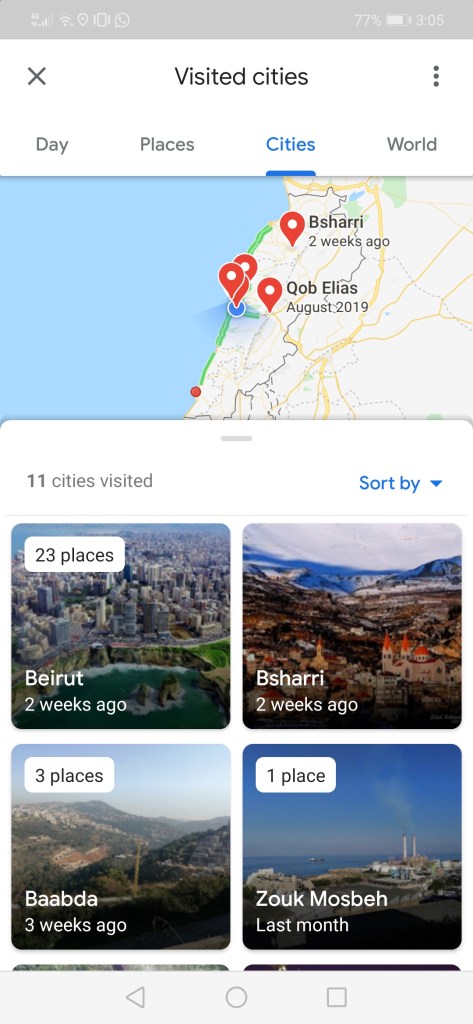
This live tracking clearly shows how my personal data is being tracked and my digital footprint is being saved. Such information can be used to tell that I like the countryside (Bsharri) or that I live in the city since most of my time is in Beirut etc. Thus, our information is made public to retailers or governments and information is tracked completely. Though some may not mind this, myself included, in the big picture it can be an issue, and we fall into political wheel of control and predicting patterns.
From destructive world wars, to brutal wars on terror, the US will defend its actions with every tool available (Anderson & Mirrlees, 2014). This is exactly what militainment means; it is the usage of various tools, such as tv shows, movies, video games, newspapers, digital media, etc. to defend and even promote its military action and recruitment (Anderson & Mirrlees, 2014). A couple of instances exemplifying this concept go as followed: first, as mentioned in the article, Call of Duty: Black Ops II was a game that advertised and promoted “the soldier in us all” (Anderson & Mirrlees, 2014). The worst problem with it being that it provided a completely unrealistic view of war, and especially death. When people play the game, especially kids (who are perfect recruitment material by the way), they get the notion that killing the enemy is such a heroic act (Anderson & Mirrlees, 2014) and dying isn’t such a big deal because one would simply “respawn”. Second, an interesting example of militainment that may seem unconventional at first is the movie Hacksaw Ridge. In this movie, the depiction of war appears to be relatively accurate and even shocking. However, this movie may be considered as the worst case of militainment because even though it shows the brutality of war, it also enforces the othering of the Japanese people (Anderson & Mirrlees, 2014), while capitalizing on the heroism of the main character regardless of his pacifism, which attracts an even wider evidence.
Reference
Anderson, R., & Mirrlees, T. (2014). Introduction: Media, Technology, and the Culture of Militarism: Watching, Playing and Resisting the War Society. Democratic Communiqué.
Surveillance has been a powerful tool since the end of the 19th century and it was especially prominent in the 20th century onward (Ball & Snider, 2013). Military forces have been prominent users of such technology, especially during world war II and cracking the Enigma code (Ball & Snider, 2013). Another fan of surveillance is commerce, especially in our capitalist world (Ball & Snider, 2013). Nowadays, with the power of surveillance, corporations have the power to control every movement their workers make, every desire their customers have and every want citizens lack (Ball & Snider, 2013). So how can we define this complex? What role does surveillance play in today’s world? In short, according to Ball & Snider (2013), surveillance is the power abused by the state in political struggles along with the control of its people’s thoughts, as well as a tool used by industries to reduce workers into numbers and production power on one hand, and commodify citizens and customers on the other. One may ask: “why should I care if my data is being surveilled? I don’t have anything to hide”. Hache & Jansen (2018), clearly explain why we must capitalize (excuse the pun) on the importance and dangers of surveillance. Data collection is not simply a matter of knowing that a person likes dark chocolate more than milk chocolate, it is a profiling of people and a destruction of opportunities depending on what algorithms deem an individual to be (Hache & Jansen, 2018). This is especially true when someone speaks out against the status quo leading to their silencing, labeling as terrorists, and in extreme cases worse.
Throughout Lebanon’s history, media has played an important role in shaping people’s beliefs mostly regarding the different political aspects on an internal level and an external one. This progression of media is clearly portrayed in a film explaining how and why certain changes occurred to media along with their implications on the Lebanese people and the politics of the country on a macro level (Majzoub, 2015). Before the proclamation of the 1994 law denoting the regulations related to news broadcasting, news sources were highly influenced by western countries to manipulate the Lebanese people (Majzoub, 2015). However, this law only fortified sectarianism and widened the gaps between the different sects and Lebanese political groups (Majzoub, 2015). Ironically, even though the law decreed that an individual may only own up to 10% of the shares of a news broadcasting channel, we find that back then, similarly to today, broadcasting channels are owned by major political leaders and influencers (Majzoub, 2015). The video further portrays how every news broadcasting channel has failed to be objective and has followed specific broadcasting methods to portray only what helps its personal cause and what appeals to a certain portion of the Lebanese people, also know as, their supporters (Majzoub, 2015). And thus, the ownership of a news broadcasting source by a political leader portrays media that benefits it; this is where the correlation becomes clear.
Contrary to popular belief, Marx did not specifically think capitalism was bad. Though he did admit it to cause pain and grief and suffering, he still admired what it succeeded to accomplish after the abolition of the feudalist system (Marx, 1867). However, Marx did believe capitalism to be a steppingstone to a final system that he considered would bring about the “end of history” (the final economic reform), communism. I share much of Marx’s beliefs, however I would go further to say that capitalism is in essence based off of evil. There is no such thing as capitalist reform or change that would bring about a better world. The truth is that capitalism lives off of the poor, and without them it would not exist to begin with. On the same note, “capitalist communications” follows a similar trend. May it be developers, retailers, advertisers or simply users, social media and communications fall under the umbrella of capitalist consumption. That is to say that all external factors (retailers, developers, etc.) consider consumers as commodity through their personal and public data, to use as tools aiming to increase profit. Internal factors are a game of popularity; the popular “own” communication platforms and their influence stems from the existence of non-popular or simple users. A link can be found between this and the way capitalism works on an economic level in real life. In conclusion, capitalism and the communications scene stemming from it is wholly based off of the oppressor and the oppressed.
Recently and for a relatively long time, racism has been quite the topic to debate in all its forms and different applications. Firstly, to define racism and its effects, it must be understood that there must exist an institutionalized oppression and discrimination of a specific race for it to be considered racism. Thus, if I insulted a white American by making fun of the color of their skin or their mental abilities (since this is a rather common joke) it cannot be considered racist unless such a “joke” has actual consequences on Americans, such as not being hired by foreign countries, in which case it would turn into discriminatory action and thus be considered racist. In terms of media, especially the visual kind, racism can be easily implemented using several tools. One such tool, mentioned in the book “Reel Bad Arabs: How Hollywood Vilifies a People”, is that of repetition especially used in Hollywood movies (Shaheen, 2003). According to the author, Hollywood movies have forever painted Arabs as terrorists or extremists or terrible people who objectify women etc. In fact, according to the book, “Only five percent of Arab film roles depict normal, human characters”. The repetition and recreation of such movies has led to institutionalized discrimination of Arabs, aka racism, especially in the US where Arabs are likely to be the first suspects of a bombing or any similar terrorist act whenever found near it (Shaheen, 2003). This unfortunately holds true for other ethnicities as well, as seen in terms of police brutality towards black and Hispanic people.
The article is called “Israel strikes Gaza after Palestinian militants unleash a barrage of rockets” (Tarnopolsky & Abu Alouf, 2019).
Bias by headline:
It clearly portrays Palestinians as terrorists by using words like “militants” along with painting the Israeli strikes as retaliation to Palestinian rocket strikes. This can also be treated as a bias through selection and omission since no context was provided as to why the Palestinians attacked to begin with.
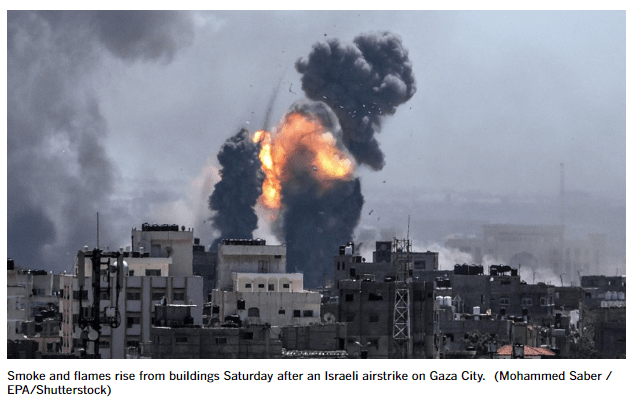
Bias by photos, captions and camera angles:
Though this picture shows a part of the horror Palestinians endure on a daily basis, it fails to humanize the situation and show much more important tragedies, most notably the loss of human life.
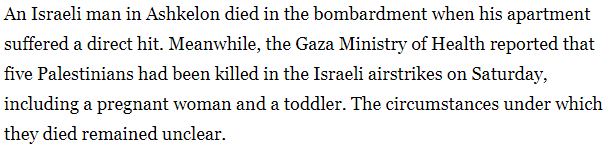
Bias by word choice and tone:
This part of the article clearly shows how the article humanizes Israeli victims by giving them a name and context for their lives, while treating Palestinians as nothing more than numbers and death tolls.
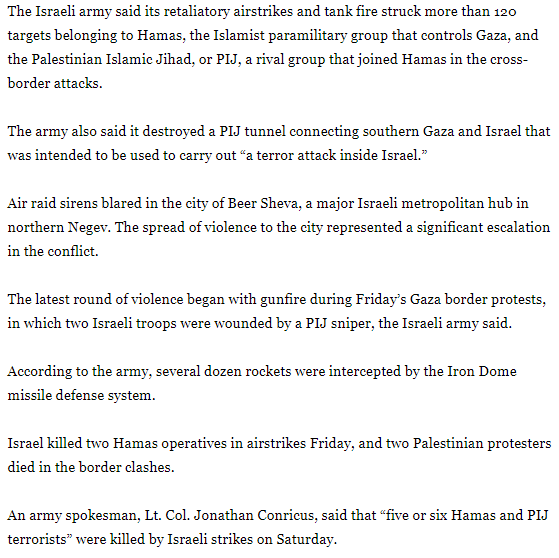
Bias by source of control:
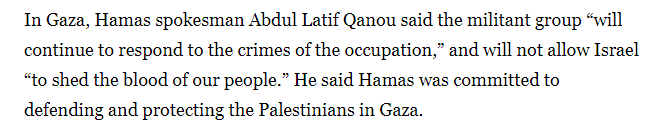
This entire part of the article clearly displays how the authors choose to only speak to Israeli officials and military figures to get intel, thus disregarding the opposite view of the situation.
Bias through placement:
As shown by previous screenshots, the article is so entirely focused on Israel’s point of view for the most part, then finally talking about Palestinian perspectives. Unfortunately, even when they finally give the opinion of a Palestinian official, they do so from an Israeli perspective by saying “the spokesman said that the militantgroup…”
Finally, and based on all that has been shown, it can be easily said that the situation was stripped of context since a lot of background information was omitted. Furthermore, Palestinian victims are always portrayed as fanatic extremists, terrorists and terrible by nature. To sum it all up, the article’s major focus was on the next steps Israel in specific needs to take moving forward, rather than shed light on the horrors that they have produced and clearly showing that they are oppressors.
As of today, we all know that foul play is deeply rooted into all forms of media. Of course, such agendas are obscure, and their origin is point of debate. Thus, we identify a model of propaganda made up of five different filters (Herman & Chomsky, 1998). Profit-ownership means that powerful figures, mostly politicians, are usually the only ones who possess enough funds and credibility to start up a media company and sustain its activity (Herman & Chomsky, 1998). Advertisements are the main source of profit for all sorts of media channels; the programs and news broadcasted, written or heard will very likely be tailored to retailers’ and advertisers’ needs (Herman & Chomsky, 1998). As for establishment, news channels will always try to maximize their efficiency by relying on credible resources such as government officials, celebrities, police departments etc. (Herman & Chomsky, 1998). Flak is arguably the most effective method for gaining the upper hand and discrediting opponents once scandal is blown out of proportion (Herman & Chomsky, 1998). Finally, The common enemy. During world war II, the Soviet Union joined the allies and fought off Germany near the end. Though it is needless to say that Stalin was a worse dictator than Hitler, he was never portrayed as such due to the United states’ continuous exploitation of the holocaust card. Thus, Hitler was the common enemy and Stalin was the lesser evil. Nowadays, such strategies are still clearly implemented, notably by Lebanese parties who forge alliances and agree to aspects they may deem unethical in the sole purpose of fighting off a bigger threat.




 Miss_Skooter